Fill in the Missing Number Worksheets: The Ultimate Guide
Beyond the Grid: Why These Printables Are Essential for Early Learners
As educators, parents, and content creators, we often look for tools that bridge the gap between play and learning. When it comes to building a solid mathematical foundation, Fill in the Missing Number Worksheets are more than just a busy task; they are a critical cognitive exercise. These worksheets challenge young minds to recognize patterns, understand numerical sequencing, and strengthen their counting fluency from 1 to 100. For the modern educator or homeschooling parent, having a reliable, high-quality resource for this specific skill is invaluable. It saves planning time and ensures that the student is engaging with content designed to build confidence through progressive difficulty.
The core concept is simple yet powerful: a sequence of numbers is presented with gaps, and the child must identify and write the missing digits. This process forces the brain to actively recall the order of numbers rather than passively reciting them. It is a fundamental step in numeracy that prepares children for more complex operations like addition and subtraction later on.
Anatomy of a High-Quality Educational Resource
Not all educational materials are created equal. When designing or selecting resources like Fill in the Missing Number Worksheets, the visual presentation and technical specifications matter just as much as the educational content. This specific collection stands out because it prioritizes clarity and usability for the end-user—whether that is a teacher in a bustling classroom or a parent at the kitchen table.
Visual Clarity and Layout
The design of these worksheets embraces minimalism and functionality. Presented in high-contrast black and white, the printables eliminate distractions, allowing the kindergartner or first grader to focus solely on the numbers. The layout is spacious, providing ample room for small hands to practice writing without feeling cramped. This is a crucial aspect of editorial design for children; the "white space" isn't empty—it's functional. It guides the eye and reduces cognitive load, making the task feel manageable rather than overwhelming.
Technical Specifications for Creators
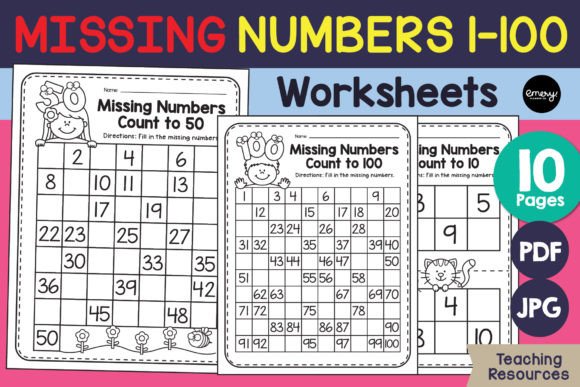
For the content creator or small business owner producing educational materials, the technical details are paramount. This pack includes both PDF and JPEG files, offering versatility for digital distribution or print-on-demand services. The dimensions are set to a standard 8.5x11 inches, ensuring they print perfectly on standard copy paper without awkward cropping. At 300 dpi, the resolution is crisp, which is essential for maintaining a professional look, even when printed on home inkjet printers. Because the files are delivered in black and white, users save on color ink—a small but significant detail that adds value to the product.
Progressive Learning: A Structured Approach to 1-100
One of the standout features of this collection is its structured progression. Learning to count to 100 is a marathon, not a sprint. By breaking the range into smaller, manageable chunks, these worksheets allow students to build confidence incrementally.
The activities are divided into specific ranges, creating a clear roadmap for mastery:
- Foundational Skills (1-10 & 1-20): These early worksheets focus on number recognition and the initial sequence. They are perfect for absolute beginners who are just getting comfortable with number formation.
- Building Stamina (1-30 to 1-50): As the range expands, the student’s working memory is challenged. They must hold a longer sequence in their mind to identify the gap.
- Mastery and Fluency (1-60 to 1-100): These advanced sheets test a child's ability to navigate the "tricky" parts of the number line, particularly the transitions between decades (e.g., 29 to 30, 59 to 60).
This tiered approach ensures that a child doesn't feel discouraged by numbers they haven't learned yet. It allows for a customized learning pace, which is a hallmark of effective homeschooling and personalized education.
Practical Applications for Educators and Parents
How you use these Fill in the Missing Number Worksheets can vary based on your environment. Here are some practical ways to integrate them into your routine:
- Morning Warm-ups: In a classroom setting, these make excellent "bell ringer" activities. They settle students down and immediately engage their mathematical brains.
- Assessment Tools: Use the worksheets to quickly gauge a student's progress. If they struggle with the 1-30 sheet but ace the 1-10, you know exactly where to focus your instruction.
- Travel Activities: For parents, these printable sheets are lifesavers during road trips or waiting rooms. They provide screen-free entertainment that is actually productive.
- Holiday Homework: To prevent the "summer slide" or holiday learning loss, assigning a few sheets a week keeps skills sharp without feeling like a heavy burden.
The Role of Design in Early Education
While we often associate terms like brand identity or visual hierarchy with corporate design, they are just as relevant in educational materials. A well-designed worksheet respects the user. It uses clean typography that mimics the handwriting style children are learning. It avoids the "cluttered" look that can cause visual fatigue.
By utilizing these digital assets, you are providing a professional-grade learning experience. The consistency of the design across all 10 worksheets helps build a routine for the child. They know what to expect, which reduces anxiety and allows them to focus on the cognitive task at hand.
Conclusion: A Staple for Every Learning Toolkit
Whether you are a teacher looking for supplemental classroom materials, a homeschooling parent seeking structured curriculum support, or a content creator looking for educational resources to recommend, Fill in the Missing Number Worksheets offer a robust solution. They combine sound educational principles with practical, high-quality design. By focusing on the 1-100 range with a step-by-step approach, they provide the scaffolding young learners need to achieve numerical fluency. Print them out, grab a pencil, and watch as the numbers fall into place.